
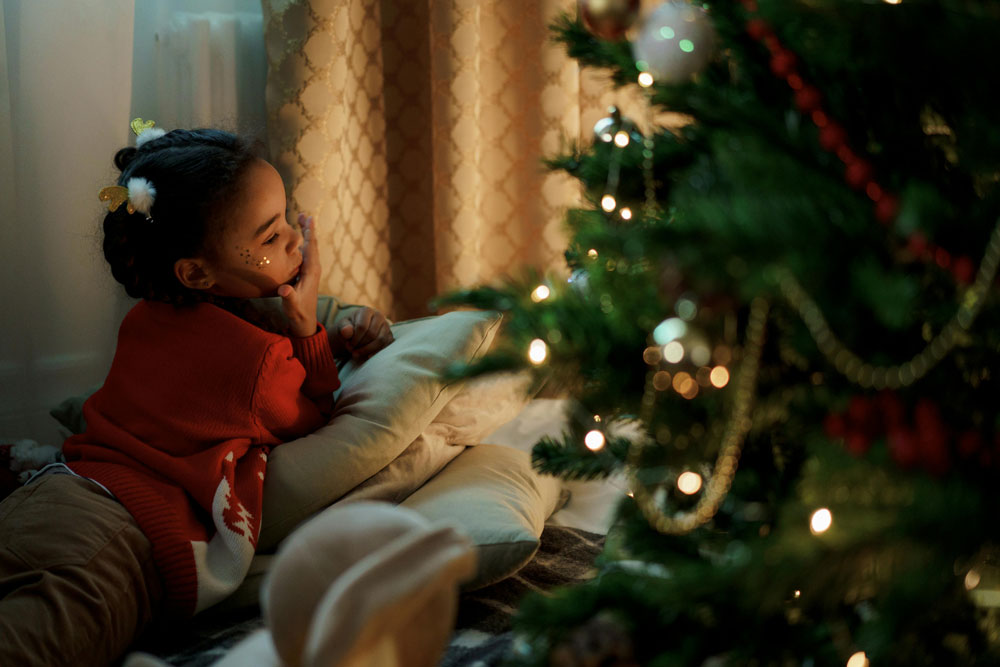
Children and the Holidays

Nov 20, 2025

Joyce Lee, LLMSW, Grief Counselor

For many children, the holiday season is full of excitement—sparkling lights, special traditions, and moments of joy. But for children who are grieving the death of someone they love, the holidays can also bring feelings of sadness, longing, isolation, and confusion. Children may feel pressure to be happy when their hearts feel heavy, or they may worry that celebrating means they are forgetting the person who died.

Children grieve differently than adults. Their grief can come in waves—moments of playfulness followed by sudden tears or quiet reflection.

During the holidays, familiar traditions may feel different without the person they’re missing. The holiday season can intensify these feelings as reminders of their loved one appear in songs, decorations, family gatherings, or simple moments like setting the table. They may ask questions, feel anger or guilt, or simply feel “off” without knowing why, or struggle to find the appropriate words to express what they are feeling. What they need most is understanding, patience, and permission to feel whatever they feel—joy, sadness, or both.

One of the most meaningful ways to support grieving children during the holidays is to help them honor their loved one. Children need permission to laugh, to cry, to remember, and to celebrate—sometimes all in the same day. Supporting them might look like lighting a candle, baking their loved one’s favorite dessert, hanging a special ornament, or sharing stories and memories. This may even include continuing old traditions or helping them come up with new ones. These acts help children feel connected, included, and seen.

Grieving children don’t need the holidays to be perfect. They need them to be real. What matters most is helping them feel included, understood, and supported—allowing room for both grief and joy. Because during the holidays, children can carry their love and their loss together.

Because when children feel supported, understood, and remembered, healing becomes possible—even during the holidays.


 

To read more about children and grief, visit our page here.

Recent Posts

Celebrating World Music Therapy Week

Celebrating World Music Therapy Week

Music therapists across the globe are celebrating World Music Therapy Week to advocate for the benefits of music therapy to improve lives all over the world. While music may sound different from land to land, music has similarities in how we express our humanity.

Did you know most countries use music in play, to accompany work, tell stories of our ancestry or culture, support spiritual identities, celebrate, sooth babies, learn information (such as the alphabet song), support times of mourning, or for simple enjoyment? Music is an accessible companion that expresses who we are and validates our emotions. While music is in one sense is a universal language; it is in another sense deeply personal and effects each individual in a unique way.

read more
The RAIN Technique for Grief

The RAIN Technique for Grief

We’ve all heard the seasonal adage that “April showers bring May flowers.” Not only does the rain create an environment which enables spring flowers to bloom, but it also offers us a poignant reminder of the importance of self-compassion. If ever there were a time to be kind and compassionate with ourselves, it would be when we are grieving – and yet, we are often our own worst critics, telling ourselves stories about how we “should” grieve. We can be impatient with ourselves, believing that grief is taking “too long” or that we are grieving “incorrectly.” It can be hard to show up for ourselves with patience and a sense of self-compassion.

read more
Navigating New Roads

Navigating New Roads

In 1997, just three years after Angela Hospice’s Livonia Care Center opened its doors, Jim Jeziorowski met someone there who would change his life forever.

Having completed his internship as a hospice social worker, Jim was considering returning to the field. Georgine “Genie” Favazza was exploring the idea of volunteering as a clown to bring cheer to hospice patients. As it turned out, Genie decided not to volunteer, and Jim went on to work with troubled youth instead of hospice patients. But their meeting at Angela Hospice was fateful one – or maybe rather a faithful one.

read more